Iranian President Labels US a ‘Terrorist’ Power, Urges Talks at UN
In a forceful UN General Assembly address, Iran’s president condemned Washington’s actions in the Strait of Hormuz while signaling openness to diplomatic solutions.
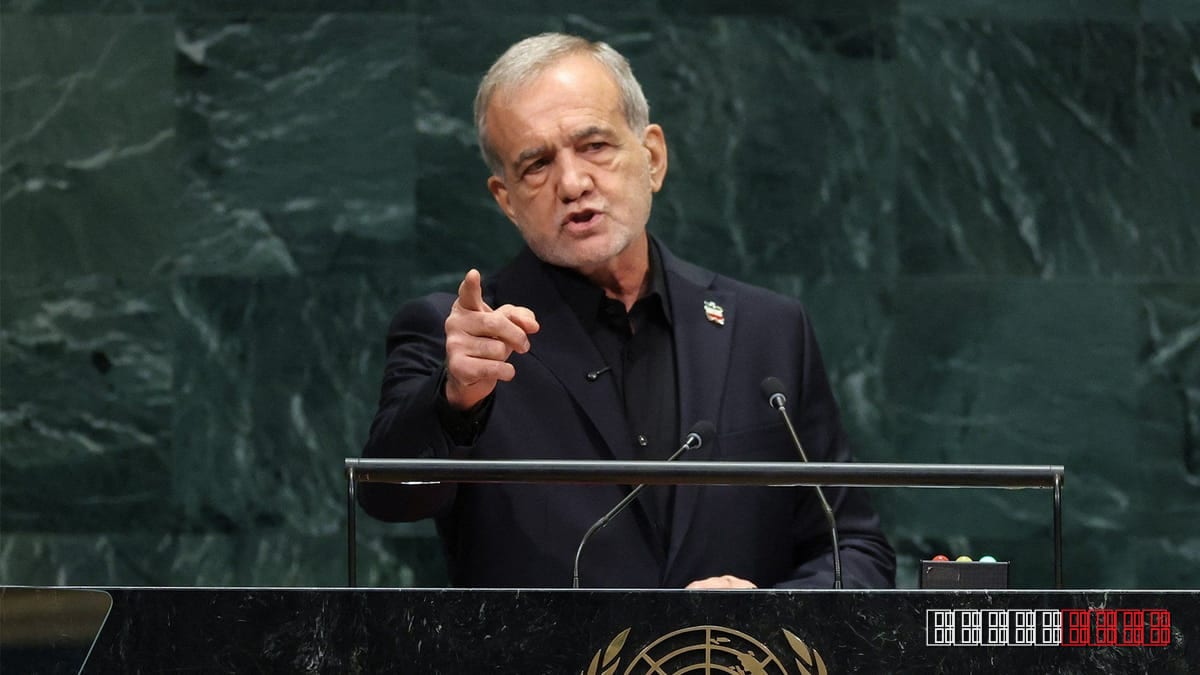
Iran’s president, Ebrahim Raisi Pezeshkian, used his platform at the United Nations General Assembly on Monday to denounce the United States as a “terrorist” state, accusing it of imposing an unlawful blockade on Iranian shipping through the strategically vital Strait of Hormuz. Al Jazeera reported that the speech highlighted what Tehran sees as a pattern of American aggression, linking the blockade to broader sanctions that have strained Iran’s economy for years.
Pezeshkian did not stop at condemnation. He stressed that Iran remains willing to engage in dialogue, urging the international community to facilitate negotiations that could defuse regional tensions. “We keep the door of diplomacy open,” he said, adding that Tehran seeks a “just and balanced” resolution that respects its sovereign rights. The president’s remarks came as the UN convened a special session on maritime security, underscoring the global stakes of any escalation in the narrow waterway that handles roughly a fifth of the world’s oil shipments.
The Strait of Hormuz has long been a flashpoint between Tehran and Washington. Since the United States re‑imposed sanctions in 2023, Iranian tankers have faced repeated inspections and occasional detentions, prompting Tehran to label the practice a “blockade.” The waterway’s narrowness—just two miles at its tightest point—means that any disruption can quickly ripple through global energy markets, a fact that has drawn repeated calls for multilateral oversight.
Experts note that Pezeshkian’s rhetoric mirrors a broader Iranian strategy of alternating hard‑line statements with diplomatic overtures. Historically, Tehran has leveraged UN forums to rally support from non‑aligned nations while simultaneously opening back‑channel talks with European powers. The current overture could pave the way for renewed negotiations on the nuclear dossier, which has stalled after the 2025 extension of the Joint Comprehensive Plan of Action.
The speech also touched on humanitarian concerns, with the president urging the United Nations to address the impact of sanctions on Iranian civilians. By framing the issue as both a security and a human rights matter, Pezeshkian aims to broaden the coalition of states willing to mediate. The UN will consider a resolution on maritime freedom in the coming weeks, a development that could either ease or intensify the diplomatic tug‑of‑war between Tehran and Washington.
While the president’s language was sharply critical, his invitation to dialogue signals that Tehran may still be receptive to a negotiated settlement, provided that any agreement acknowledges its regional interests and lifts what it deems an illegal blockade.
This report is based on original reporting by Al Jazeera. Read the original source →