Microchip Generates Spectrum of Light to Expand Future 6G Bandwidth
A newly demonstrated chip can emit several stable colors of light at once, offering a pathway to carry more millimetre‑wave signals in upcoming 6G networks.
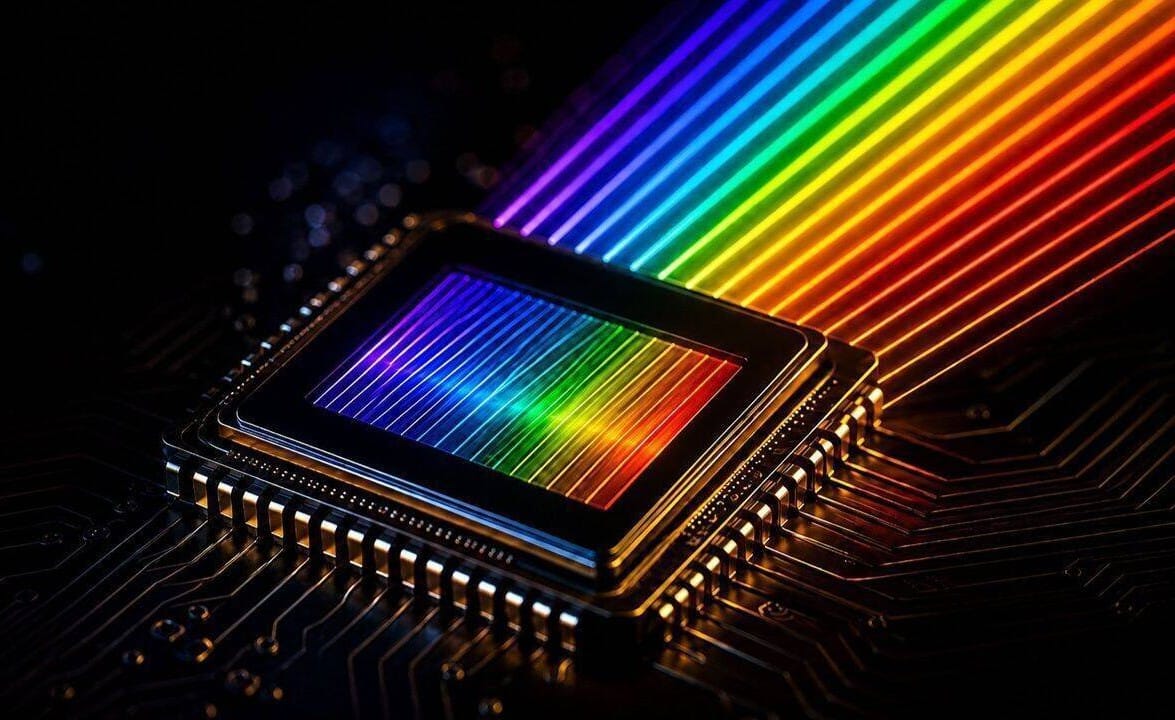
Scientists have unveiled a miniature photonic device that produces a suite of stable light frequencies simultaneously, a capability described as a “rainbow on a chip.” By converting these optical tones into millimetre‑wave signals, the technology promises to increase the number of channels that future 6G networks can handle, addressing the massive data‑rate demands projected for the next generation of wireless communication.
The chip’s operation hinges on generating multiple, precisely controlled wavelengths of light within a single silicon‑based platform. Each wavelength can be independently modulated and then up‑converted to the high‑frequency millimetre‑wave band that 6G is expected to exploit. Because the optical sources are inherently stable, the resulting radio‑frequency signals can be stacked more densely without the interference that plagues conventional electronic transmitters.
Beyond telecommunications, the researchers highlighted the chip’s potential for quantum‑technology timing applications. The ability to produce exact, repeatable light frequencies could serve as a highly accurate clock reference for quantum processors, where timing precision is critical. This dual‑use nature underscores the broader impact of integrating photonics and microwave engineering on emerging tech ecosystems.
While laboratory tests have confirmed the concept, the team acknowledges that several engineering hurdles remain before commercial deployment. Scaling the fabrication process, ensuring compatibility with existing 6G infrastructure, and meeting power‑efficiency targets are among the challenges slated for future work. Nonetheless, the demonstration marks a significant step toward leveraging photonic integration to meet the spectrum crunch anticipated in the post‑5G era.
If refined, the “rainbow on a chip” could become a cornerstone of next‑generation network hardware, enabling carriers to transmit more data streams simultaneously while maintaining signal integrity. The development aligns with global efforts to lay the groundwork for 6G standards, which are expected to be defined in the coming decade.